


Steve de Shazer's miracle question is now familiar to all coaches: "Imagine that a miracle has happened during the night and your problem is solved! How do you know that this is a problem? How did the problem come to be solved?"
Problem identification
In front of me stands a trembling heap of misery, or more precisely, an angry, trembling heap of misery. The misery is called Verena. She is sour, stinking upper sour, megast upper sour! Angry with the management team of her project.
"I now go to this top bottle of program director and throw the beggar at his feet. Let him find an idiot like himself for the job!"
I nod, show that I understand her and then penetrate a little below the sensitive, billowing surface of her mental framework. What I perceive frightens me a little. The façade that has allowed them to speak so firmly and harshly is only very thin and, above all, unstable. I ask her if she can sleep:
"Of course not! I haven't slept through the night for weeks and not at all for two days!"
She is mentally and physically quite exhausted and on the verge of crying fits. She rails against this and that and how unjustly she is treated.
What can I do to alleviate the worst need and bring Verena into a state that enables meaningful work on the actual problems? Verena seems to have a classic problem situation that presents itself to me again and again: She feels solely responsible for the success of the project and of course the project only succeeds if all tasks are done "correctly" and not "wrongly". However, this core problem is hidden under a layer of great frustration and even more pain!
Problem Materialization
I choose an approach that could perhaps be described as a spatial variant of Steve de Shazer's famous "miracle question": "Imagine that a miracle has happened during the night and your problem has been solved! How do you know that your problem has been solved? How did the problem come to be solved?"
From a linguistic point of view, this is a "systemic" interaction. It forces the client to leave his or her own, problematic perspective and to look at the problem from the outside and in time separately. It must leave the associated "1st position" and take a disassociated "3rd position". De Shazer's question provides a solution orientation through language, i.e. auditory. How could the path to the "solution" be represented kinesthetically, i.e. in three-dimensional space?
I asked Verena:
"If what is bothering you right now and making you angry and disappointed were a symbol or an object, what kind of symbol or object would it be?"
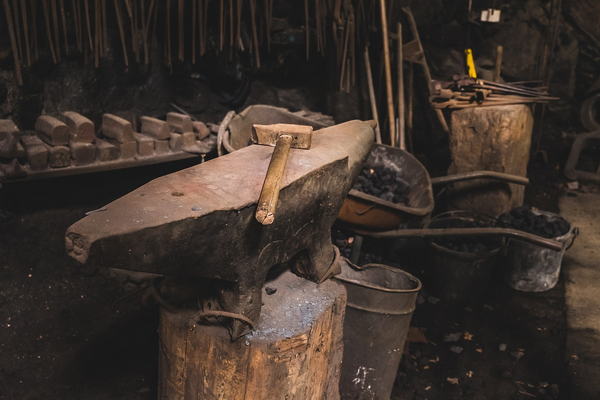
"An anvil! Ugly, big and black."
"Where in the room is this anvil? In front of you, behind you, right or left?"
"He's standing right in front of me, there!"
She points to a point directly in front of her.
"How far away is he in meters in front of you .... and... if the anvil had eyes, where are they looking?"
Again she points to an imaginary point in front of her in the room. However, now a little higher.
"He's about a meter and a half in front of me and his eyes are staring at me! Wow, it's ugly and dark!"
What I have done here is an application of the Mental Space Psychology from Lucas Derks .[1] The anvil is now firmly attached to the problem and we have built up the context that is linked to Verena's bad feeling.
Now comes the peculiarity of this "miracle process". I don't care why it's an anvil or why she feels bad.
"Why? Why? Why?"
This standard question does not solve any problem. It only gives a static answer as to what the alleged cause could be. One can then endlessly ask what the why of the why is, up to Judgment Day and beyond. It is much more efficient to let the problem materialize in 3-dimensional space and then ask how "what is the case" [2](Wittgenstein). Perhaps you could say that I work with the form or structure of the problem and not with its content.
Resource Activation
So the object that makes Verena feel bad is an anvil that is in her field of vision at the front. Now I ask about the connection between anvil and feeling:
"How do you feel? What is it like for you when the anvil is in front of you?"
"I feel lousy and nauseous and have a piercing pressure in the pit of my stomach. It also presses against the solar plexus! The anvil hinders me! He's in my way!"
Now I'm going beyond her frame of thought by asking her something she has probably never asked herself before:
"What's behind the anvil? What does the anvil hide from you?"
"What's behind the anvil? No idea! How am I supposed to know?"
With this question, I am realigning their attention! Away from the bad feeling, towards something new. She is feeling better at the moment. Then I instruct her to imagine how she steps out of "Verena" so that "Verena", who has the anvil in front of her, remains in the same position. She should walk around the anvil, and please go to the place of the room that is immediately behind the anvil as seen from "Verena". In other words, to the place that is "beyond" the problem manifestation.
Verena steps out of "Verena" with a clear step and makes a small arc around the place in the room where she materialized the anvil. I accompany her by touching her arm and walking with her. Arriving behind the anvil, I ask her to close her eyes and say:
"Verena, you're now on the other side of the anvil and "Verena" is standing back there. Correct?"
She confirms my statement.
"Verena, what do you perceive with your senses in this position? How do you feel here?"
Often, clients already feel really good at the point beyond their obstacle. Every now and then, as it turns out with Verena, it's not okay here yet:
"It's pitch dark here! I don't see anything. It feels tight."
"What do you hear? What do you feel?"
"Yikes! I'm standing in an elevator car! The walls are metal and cool!"
Even if the associations of the clients are sometimes surprising, it is important to simply accept them and take them seriously. When the client ends up in an elevator, as a coach you accept this map and work with it.
It seems that the smell and taste receptors are most directly linked to the limbic system in the brain. Therefore, it is interesting to find out whether there are "bad" sensory perceptions here.
"What do you smell when you're inside that elevator car? Do you have a special taste in your mouth?"
Verena says that the taste is neutral, but the air smells musty. I continue to move on Verena's map.
"Where is the door? Can you leave the elevator car?"
Verena turns a little to the side.
"Yes, there is a door. But the door is closed! I can't get them open!"
I answer with precise fuzziness:
"There are buttons and switches in every elevator car! Try to open the door!"
"The door opens a crack!" she says strainedly.
"Keep going! Open the door!"
Verena pants loudly: "I made it! The door is open!"
"Please leave the elevator car and go outside! – What's there?"
Verena takes two steps in the room.
"There is a landscape! I'm standing in a meadow! There are flowers! It smells good! It's beautiful here!"
I let Verena linger a little in her obviously beautiful experience.
"Verena, how do you feel in this place?"
"I'm fine! I feel joy... Freedom... Silence!"
"How would you like to describe the sum of the individual feelings? Give me a term for it."
"Hmmmm ... I am with myself ... hmmmm ... I am centered and grounded!"
"You are centered and grounded here, which fills you with joy. That's a good feeling – right?
"Yes, I'm fine!"
"Could it be that Verena back there – behind the elevator and the anvil – doesn't have this feeling, but would need it?!"
Verena sighs and confirms:
"Oh yes, that's right!"
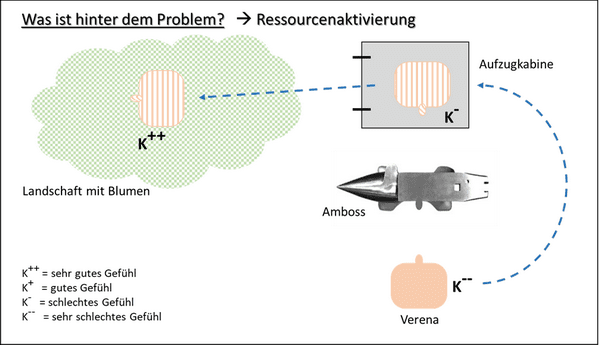
We have now found out in a very short time which resource "Verena" is missing in her problem state. This method works exclusively with emotions in the room. It does not need to work out logic or motivation (positive intention).
Problem solving
Now I use this feeling of "centeredness" and "being grounded" as a resource in the form of an energy that "the woman in the flower meadow" feels in her whole body. My coachee determines the color of the energy – in this case "red". Then I ask them to let this resource flow in the form of a thick red beam of energy through the elevator, through the anvil into "Verena". The energy flows through "Verena" and fills the whole body!
"Let it sink in... and perceive what is changing, ... while the red energy is pouring in... and streams... what happens? “
Verena cries out in amazement: "The anvil is shattering into pieces!"
"Let the red energy continue to flow... to be centered ... to be grounded... What happens next?"
"The anvil parts are getting smaller – they are dissolving – they are moving to the side!"
I now ask you to leave the place on the flower meadow while the energy continues to flow and to "flow" with the energy to Verena, and to flow into "Verena" with the feeling of centeredness and the feeling of being grounded and then to become her. As Verena "flowed through" the room and took the position and perspective of her original perspective again, I ask her again what has changed.
"I feel free. The pressure is gone. It's pleasantly warm at the level of the heart!"
What is left of the anvil floats in the air to her right. I ask her how she feels about the remnants of the problem. She says that it feels neutral, she simply "doesn't care".

Sustainability
I am still checking the sustainability of the solution after the All-Quadrants-all-Levels Model (AQUAL) by Ken Wilber, by checking whether "Verena" (1st position) is now doing well or whether she would need something else. She says everything is fine. I also want to know if the anvil remnants (2nd position) are doing well in their new position. Here, too, everything is fine. I also check whether an observer from the outside (3rd position) perceives the new constellation as "okay". When I place it high up on an imaginary moon (4th position) to experience the entire system including past, present and future, something disturbs. Verena receives another resource, the check of all perspectives is repeated and now the solution is appropriate and good from every angle!
Verena now feels relaxed and free!
With this good feeling, I send them on a walk around the building. That was exhausting enough for that moment. She should walk alone and, if possible, not talk to others. Verena trots away, a little exhausted and with a cheerful face.
Result
Has the problem now been "definitively" solved? No, but she can now sleep again and in the next few days we will find out what makes Verena take on all responsibility. Then perhaps another miracle will happen. What would Steve say about that?
[1] Derks, Lucas : The Game of Social Relationships – NLP and the Structure of Interpersonal Experience. With a foreword by Wolfgang Walker. Klett-Cotta, Stuttgart (2000)
[2] from Tractatus logico-philosophicus by Ludwig Wittgenstein. "What is the case, the fact, is the existence of facts."
